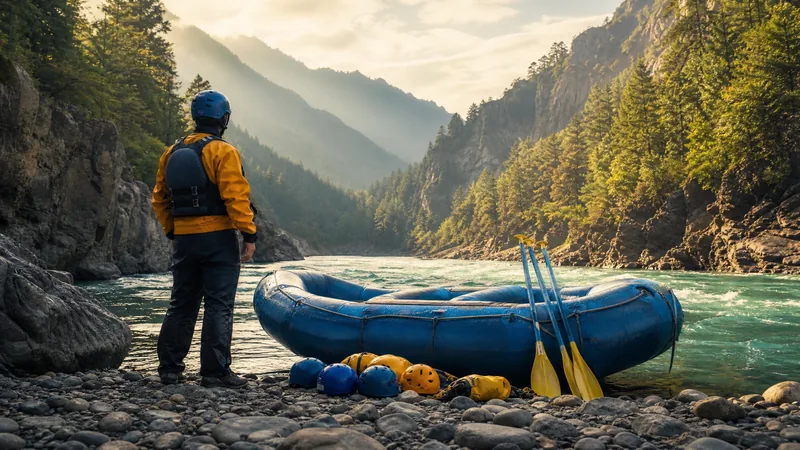
How to Start a Whitewater Rafting Company in West Virginia: DNR Whitewater Commission Licence
How to Start a Whitewater Rafting Company in West Virginia: DNR Whitewater Commission Licence
West Virginia has some of the best whitewater in the East, and the state controls who can take paying customers down its designated rivers. If you want to know how to start a whitewater rafting business in West Virginia, the licence from the DNR Whitewater Commission is the step that decides whether you can open at all. The LLC filing, tax registrations, city rules and insurance all fit around it. This guide covers the steps in the order most owners find works.
This article is general information, not legal or tax advice. Rules, fees and deadlines change. Confirm each one with the agency named before you spend money, sign a lease or book trips. For a commercial operation with employees, equipment financing or real estate, work with a West Virginia attorney and a CPA.
What You Need Before You Start
- A business name that passes the Secretary of State search, and a filing plan (most owners choose a limited liability company)
- A $250 non-refundable DNR application fee
- The $500 annual licence fee once approved
- A $1,000 surety bond payable to the State of West Virginia
- Public liability insurance of at least $300,000 per occurrence for bodily injury and $25,000 aggregate for property damage
- Rafts, life jackets, throw bags, and first aid gear ready for an inspection by a DNR Natural Resources Police officer
- Current first aid and CPR certification for every guide
- Written put-in and take-out access, including landowner permission and parking
- A $30 Business Registration Certificate from the WV Tax Division
- A business bank account and a bookkeeping system you will keep current
Step 1: Form Your Entity and Register the Name
Most small outfits form a limited liability company (LLC). The filing is the Articles of Organization (Form LLD-1) with the West Virginia Secretary of State. The filing fee is $100. Standard processing takes 5 to 10 business days. If you need the company on record sooner, expedited options cost extra: $25 for in-person same-day or next-business-day service, $250 for a 2-hour turnaround, and $500 for a 1-hour turnaround, each in addition to the filing fee. Filing online through the WV One Stop Business Portal at business4.wv.gov adds a $1.00 processing fee.
The name must contain “limited liability company,” “limited company,” or an abbreviation such as LLC, L.L.C., LC or L.C. (WV Code 31B-1-105). It also must be distinguishable from every name already registered or reserved. Search the business database at http://apps.sos.wv.gov/business/corporations/ before you commit to a name. To hold a name while you finish paperwork, reserve it for 120 days for $15 at https://sos.wv.gov/reserveregister-business-name.
A registered agent is optional. Form LLD-1 asks for an agent for service of process “if any,” and state law makes the Secretary of State your attorney-in-fact for service, so the state can always accept papers for you. Many owners name a local agent anyway because they are often on the river. Changes to the agent are filed on Form AAO for $15.
Your LLC files an annual report with the Secretary of State each year between January 1 and June 30 for the $25 fee. A report filed after June 30 costs $75 because of a $50 late fee. Note that this filing does not make you licensed to guide. It is a registration of the company, nothing more.
If your public name differs from the LLC name, for example a river brand such as a trade name, file a trade name registration with the Secretary of State, not a county clerk. An LLC files Form NR-3. The fee is $25, plus a $1.00 processing fee if you file through the online portal. Details are at https://sos.wv.gov/business/registration-and-waivers/register-trade-name-dba.
Step 2: Send the Letter of Intent to the DNR Director
Commercial whitewater outfitting on the designated rivers is governed by W. Va. Code 20-2-23a and 20-2-23d. You begin with a letter of intent addressed to the DNR Director, paid with the $250 non-refundable application fee. The DNR Law Enforcement Section handles applications. Call 304-558-2784 or email [email protected] before you send anything, and confirm the current application format and any required attachments, because the Section sets the process.
Timing is the most common planning error. Applications received by March 15 are considered for a licence taking effect January 1 of the following year. An application received by March 15, 2027, for example, is considered for a licence effective January 1, 2028. If you want to run in a given season, count back from that January 1 date. Do not sell trips or take deposits until the licence is actually issued.
Step 3: Understand the Licence Term and Fees
Once approved, the annual licence fee is $500 per licence each year. The statute says the licence is issued for ten years as long as the annual fee is paid. If the fee goes unpaid, the licence is suspended, so put the renewal date on your calendar the day you receive the licence.
The statute frames the $500 fee per designated river during the Commission’s study period: the Cheat, Gauley, New, Shenandoah and Tygart. An outfitter licensed on a designated river pays no extra for its other rivers. Ask the Section how the fee applies to each river on your route and whether the amount changes once the study period ends. Get that answer in writing.
Step 4: Post the Surety Bond and Buy Liability Insurance
Before you offer services, you need two financial protections in place. The first is a $1,000 surety bond payable to the State. The second is public liability insurance of at least $300,000 per occurrence for bodily injury and $25,000 aggregate for property damage. Those are minimums. A rafting accident can produce claims well above them, so ask a commercial broker who writes outfitter policies whether to buy more.
The bond premium is set by the surety company, not the state, so get a quote rather than assuming a number. Ask the broker to confirm that the policy meets the statute’s wording before you submit the application, since a policy that falls short can delay your inspection.
Step 5: Pass the Equipment and Location Inspection
A DNR Natural Resources Police officer inspects your equipment, your location, and your first aid and CPR certification. Inspectors look for the same things they would look for in any safety review: rafts and flotation in working condition, rescue and throw gear present, a complete first aid kit, and documented certifications. Keep a folder with each guide’s certificate, its issue date and the issuing organization.
Set the inspection date with the Section once your bond and insurance are in hand. Walk the put-in and take-out yourself beforehand so you can answer location questions without guessing.
Step 6: Set Up Trip Reporting and the Study and Improvement Fee
Outfitters report users and trips to the Commission. The Commission may also set a study and improvement fee that outfitters owe per user. Ask the Commission for the current per-user amount before you set prices, because that number changes what a trip costs you. Do not guess it from older price lists.
Start a trip log on day one. Record the date, river, number of guests, guides on duty and any incident you are required to report. A log kept as you go is much easier to file than one reconstructed at year end from booking emails.
Step 7: Check Whether a General Outfitter Licence Also Applies
The whitewater licence covers guiding on the designated rivers. A separate general outfitter licence covers non-whitewater guiding. If your packages include calm-water floats, guided hikes or other non-whitewater activities, confirm with the Law Enforcement Section which licence each one requires. Offering a package that mixes both without the right licence for each part is an avoidable compliance risk.
Step 8: Register With the State Tax Division
West Virginia has no general statewide business license. The closest equivalent is the Business Registration Certificate from the WV Tax Division. It costs $30 as a one-time fee, is permanent until your business name, location or ownership changes, and is required for each fixed business location. Apply on Form WV/BUS-APP or online at business4.wv.gov. Registering your LLC with the Secretary of State does not replace it, and the certificate must be in place before you begin business activity.
Trip fees, gear rentals and merchandise may be subject to sales tax. The state rate is 6%. Apply for a sales tax permit through the Tax Division at https://tax.wv.gov/Business/BusinessRegistration/Pages/BusinessRegistration.aspx, and ask the Division how to classify each revenue line before you start charging.
Step 9: Check City Taxes and Licences
West Virginia has 55 counties and 230 incorporated places, and many of the local costs come from the city, not the state. Cities levy the gross receipts business and occupation (B&O) tax that hits most services, and they may also require a city business licence and a weekly per-worker city service fee. The state B&O tax applies only to utilities, so do not assume a state B&O filing covers you. Which city applies depends on where your office, shop or staff base sits, so check with that city’s clerk before you open.
Some cities also add a 1% local sales tax on top of the 6% state rate. Today 101 municipalities do so, and that number rises to 107 from January 1, 2027. Ask the Tax Division and your city which rate applies to your address.
Step 10: Handle Alcohol, Staff and Owner Taxes
If you plan to sell beer or wine on trips or at a base, the Alcohol Beverage Control Administration (ABCA) licenses those sales. Confirm before you sell anything. If you hire guides, register as an employer with the Tax Division and ask your insurer and CPA about workers’ compensation and payroll setup. Guides are often the largest operating cost of a rafting company, and their paperwork is the easiest to neglect.
For tax purposes, an LLC is a pass-through entity. It pays no state franchise tax and no corporation net income tax, and members report income on the personal income tax, which runs from 2.11% to 4.58% for tax year 2026. A corporation pays a 6.5% corporation net income tax on federal taxable income. Which structure fits your situation depends on your profit, your partners and your plans to raise money, so discuss it with a CPA before you file.
Tips and Common Mistakes to Avoid
- Booking trips before the licence. Deposits taken before the licence is issued create refund obligations you may not be able to meet.
- Treating the LLC filing as a licence. The Secretary of State filing is a registration. The DNR licence and the Tax Division certificate are separate requirements.
- Missing the March 15 deadline. A late application pushes your first licensed season back a full year.
- Buying insurance after the application. Bond and insurance must be in place before you offer services, so get quotes early and bind the policies before the inspection.
- Filing a DBA with the county clerk. Trade names go to the Secretary of State.
- Letting the annual report slip. The window closes June 30, and a late filing costs $75 instead of $25.
- Assuming the state B&O tax applies to you. Most business and occupation tax is set by cities, so the local answer is the one that matters.
- Setting prices without the study fee. Ask the Commission for the current per-user amount before you publish rates.
- Missing the annual $500 payment. An unpaid fee suspends the licence, and a suspended licence cannot support trips.
Expected Results
A well-prepared applicant may be able to move from entity filing to a licensed season within one planning cycle, but the Commission’s calendar controls the timing, not your enthusiasm. The owners who tend to launch on schedule are the ones who file early, book their bond and insurance before the inspection, and keep their reporting current. Results will depend on your river, your inspection and the Commission’s decisions, so treat any timeline in this article as a planning estimate and confirm each step with the agency.
Estimated Costs at a Glance
| Item | Cost | Agency | Notes |
|---|---|---|---|
| Articles of Organization (Form LLD-1) | $100 | WV Secretary of State | Plus $1.00 if filed online; expedited options extra |
| Name reservation | $15 | WV Secretary of State | Holds the name for 120 days |
| Annual report | $25 | WV Secretary of State | Due January 1 to June 30; $75 after June 30 |
| Trade name (DBA) for an LLC | $25 | WV Secretary of State | Form NR-3; plus $1.00 if filed online |
| DNR application fee | $250 | DNR Director | Non-refundable; send with letter of intent |
| DNR annual licence fee | $500 | DNR Whitewater Commission | Each year; licence runs ten years while paid |
| Surety bond | $1,000 bond amount | Payable to the State | Premium is set by the surety company |
| Liability insurance | Minimum $300,000 per occurrence; $25,000 aggregate property | Private insurer | Minimums only; get a quote |
| Business Registration Certificate | $30 | WV Tax Division | One per fixed location; permanent |
| State sales tax | 6% | WV Tax Division | Ask how each revenue line is taxed |
| City licence, B&O and service fee | Check with city | Your city | Rates depend on your address |
| Study and improvement fee | Check with Commission | DNR Whitewater Commission | Per-user amount set by the Commission |
Next Steps
Start with the two calls that set your timeline: the DNR Law Enforcement Section at 304-558-2784 for the licence process, and the Secretary of State search at http://apps.sos.wv.gov/business/corporations/ for your name. Then line up your bond and insurance quotes, and calendar the March 15 application date. The Secretary of State’s general business page at https://sos.wv.gov/business and the Tax Division at https://tax.wv.gov/ cover the filings in the later steps. The West Virginia Small Business Development Center at https://wvsbdc.com/ can review your plan at no charge, and the SBA district page for West Virginia is at https://www.sba.gov/district/west-virginia.
Because a rafting company combines a state licence, insurance obligations, employees and local taxes, have a West Virginia attorney and a CPA review your structure before you sign anything.
Keep exploring: related West Virginia guides
- How to Start a Logging or Timber Business in West Virginia
- How to Start a Zipline or Adventure Park in West Virginia
- How to Start a Hunting or Fishing Guide Business in West Virginia
- How to Start a Campground or RV Park in West Virginia
- How to Start an LLC in West Virginia
- West Virginia Business License
- How Much Does It Cost to Start a Business in West Virginia
- All West Virginia business types
- Every West Virginia guide in one place